
Meet Dr. Amy Runck, Biology Department Chair and Professor at Winona State University.
She has worked closely with Mayo Clinic to establish a joint Medical Imaging bachelor’s degree to prepare students for the ever dynamic medical field.
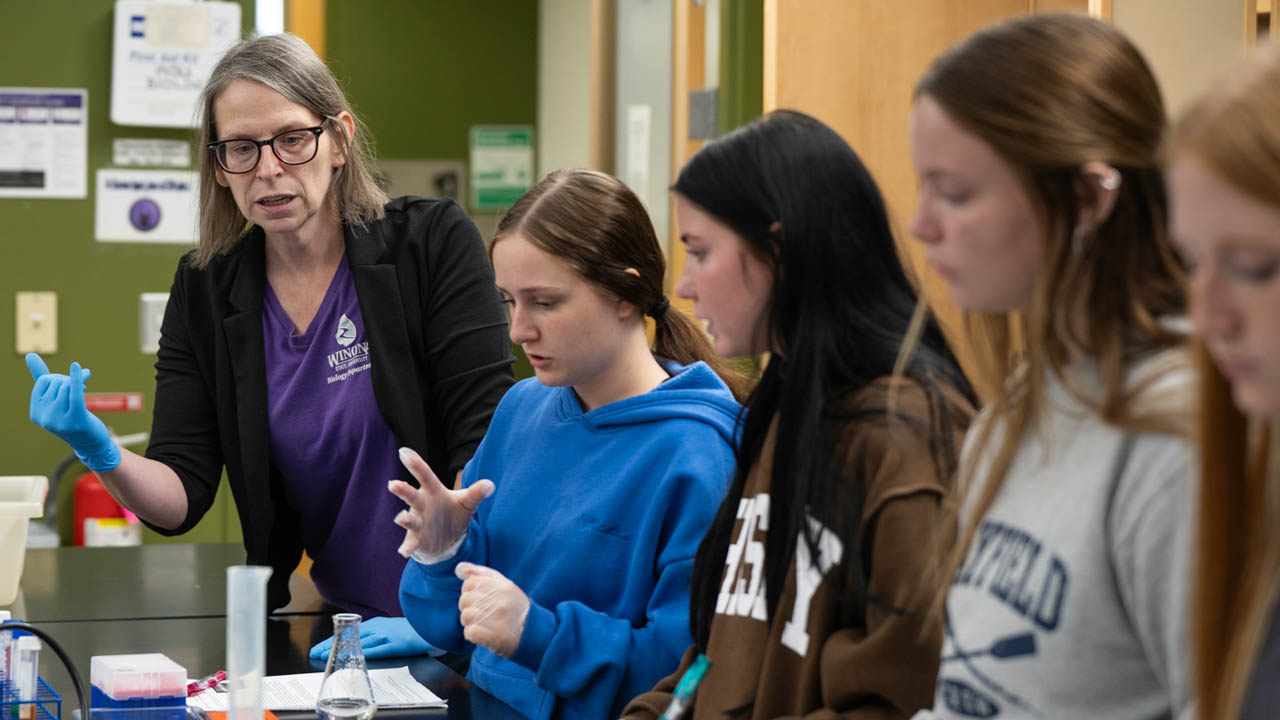
Who Is Dr. Amy Runck?
Amy Runck began working at Winona State in 2010.
With her background in molecular ecology, she was drawn to the City of Winona because of its location in the Driftless Region and the potential it held for furthering her biology research.
Today, Runck views her accomplishments through the lens of her students’ successes:
“I am really proud about how the research that I do with my students helps them open up doors for future employment, graduate programs, and professional programs.”
Her favorite class to teach is BIOL 241: Basics of Life. She loves working with first-year students and watching them grow in their independence as learners:
“Introductory courses aren’t for everybody. But I enjoy that discovery phase for those students.”
She believes that the first year is a valuable moment for college students to hone their skills and learn what programs are right for them—and she helped shape the new Medical Imaging program with this in mind.
What Is the Medical Imaging Program?
Thanks to Amy Runck’s leadership, Winona State partnered with the Mayo Clinic School of Health Sciences to give our students the opportunity to work with one of the greatest healthcare systems in the world.
The Medical Imaging bachelor’s degree currently offers 5 concentrations that students can take to prepare for specialized careers:
- Radiography
- Sonography
- Echocardiography
- Nuclear Medicine Technology
- Magnetic Resonance Imaging (MRI)
The program launched in 2020 and has more than 200 enrolled students today.
No matter the concentration they select, students will spend the first half of the Medical Imaging program completing prerequisite coursework at Winona State, then they will spend the second half studying at Mayo Clinic to complete their professional clinical training.
The Medical Imaging bachelor’s degree will ultimately prepare students to work with the newest technologies and gain experience caring for patients—all before graduating and entering the workforce.

Why Study Medical Imaging at Winona State?
Since pushing for the Medical Imaging program to launch, Amy Runck keeps an eye on not only what her students need but also how the the medical and biology fields are changing to determine the best way that Winona State can ensure success:
“We’re always reevaluating [the program] and making sure that we are preparing our students as best as possible.”
Students in the Medical Imaging program can also join a specialized orientation group to get acquainted as first-years, participate in early shadowing experiences to understand what the job entails, and become members of the Medical Imaging Club to further expand their knowledge and build connections with other students in the program.
Another way that Winona State helps students succeed is by offering personal advising that ensures students are on the path that’s right for them. The Medical Imaging bachelor’s degree even provides an alternative for students who thought they wanted to major in nursing, which can be a competitive program to get into.
“This is a great place to change your major because there are so many opportunities for our students here. It’s a good overall safety net,” Runck states.
What first started as only a Radiography program, the Medical Imaging bachelor’s degree has grown significantly due to industry demand. The 2025 median annual salary for Radiologic and MRI Technologists is $81,000; for Diagnostic Medical Sonographers, $96,000; and for Nuclear Medicine Technologists, $101,000.
Medical Imaging will continue to expand its offerings to further cater education and clinical experience at Winona State.