
Hands-on experience producing and editing video and audio is something that can set today’s students up for success in a variety of fields.
Think about it: Schools need content that makes learning fun for children. Businesses need to promote their products and services across different channels to grow revenue. And viewers need films and television shows that tell unique, captivating stories.
That’s why Winona State University offers multiple academic programs that allow students to play around with Adobe programs and gain these skills.
From Mass Communications to Film Studies, many Winona State students are graduating into fields that require them to work with digital media and have experience with modern tools and software.
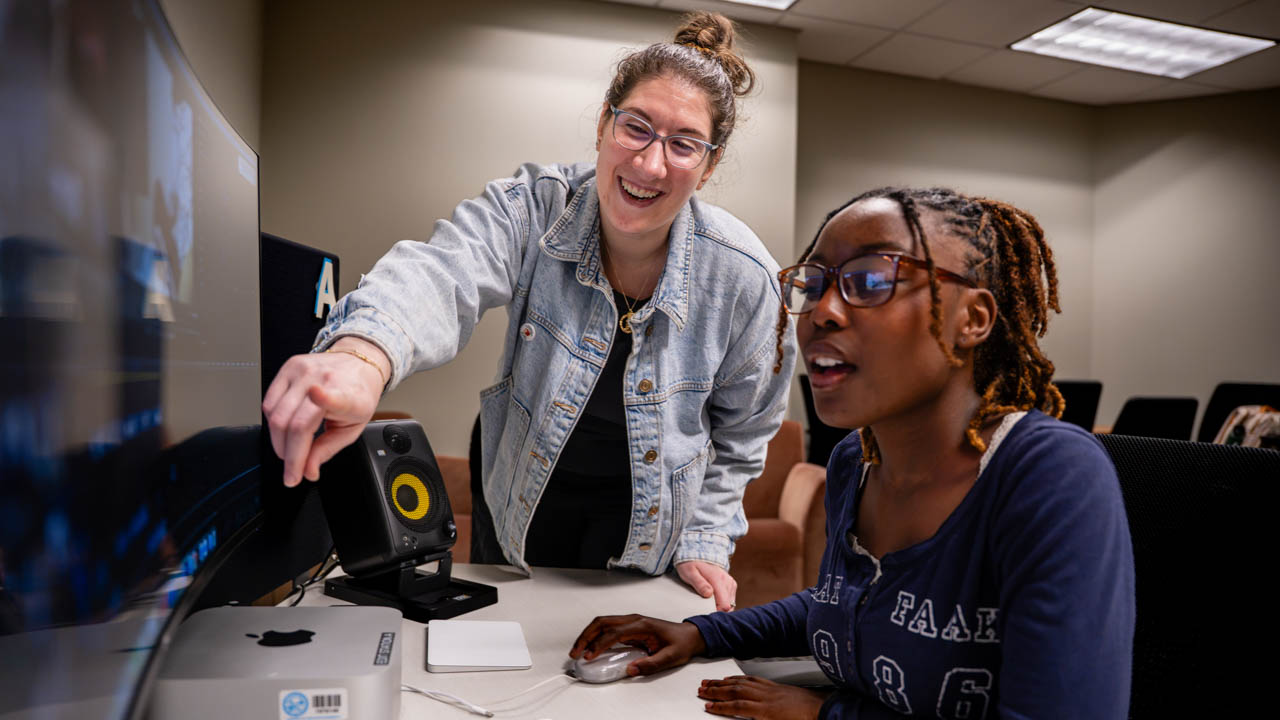
For this reason, Dr. Danielle Schwartz, Associate Professor of Film Studies at Winona State, helped create a campus space for students to access professional video and audio editing equipment.
Who Is Dr. Danielle Schwartz?
Danielle Schwartz attended Michigan State University, informally studying film studies after joining a film club and discovering her passion for the industry.
In between graduating with her bachelor’s degree and returning to Michigan State for her master’s degree, Schwartz gained experience in the field. She grew her skills by working on a low-budget horror film, then she moved to LA to pursue actress assistant jobs and to create trailers and marketing content for different productions.
During her time in LA, she worked as a production coordinator on the first Hobbit movie, working behind the scenes with producers and assistant editors. She put in long shifts, averaging 18 hours of daily work—and even one instance of 25 hours straight.
“I realized that I really enjoy when I watch a movie, watching other people watch it. I’m really interested in the audience’s experience, maybe a little bit more than in making films.”
- Schwartz says this interest pushed her to pursue her master’s degree in film studies—specializing in American teen films, feminisms, and decolonial studies—and later her PhD at Binghamton University.
What Brought Her to Winona State?
“I never thought I’d live in Minnesota in my entire life because I thought it was way too cold,” Schwartz says. But the community of Winona moved her in such a way that she knew it was where she was meant to be.
Today, she appreciates the broad support within the Winona community. Winona is also home to the Frozen River Film Festival, which is the only all-documentary film festival in Minnesota and screens a variety of independent films highlighting unique world perspectives.
Since partnering with the Frozen River Film Festival and setting up public screenings for her own students’ exhibitions, Schwartz says that she has noticed the vast amount of the community that will show up to support her students.
“It’s made it really easy to want to serve not just the students but also the greater Winona area.”
She aims to give back to the community as much as they have encouraged her and her students throughout her time teaching at Winona State.
One way Schwartz carries out this goal is by paying attention to the needs of her students and working to give them every opportunity to succeed—including an on-campus editing bay stocked with professional video and audio editing equipment.
How Does the Editing Bay Help Students Succeed?
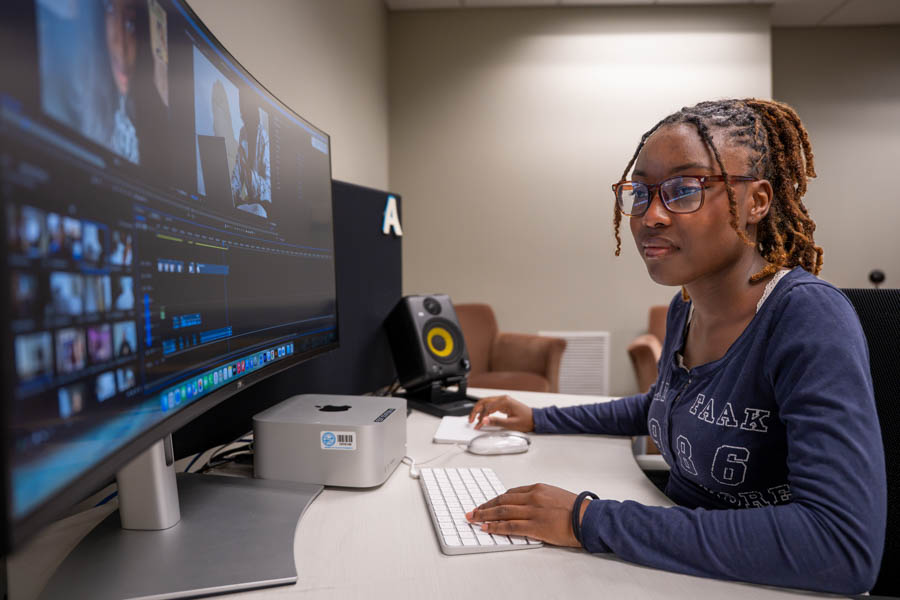
Prior to the editing bay, Film Studies students edited their projects off their MacBooks, which do not generally have the space and processing speed needed for the longer and higher quality works that Winona State’s professors wanted to cultivate.
Schwartz presented a comprehensive report of how she wanted to create a new learning space on campus to address this problem, and she earned $40,000 in state legislative funds to set her plan in motion.
Now, students have access to Adobe products, a library of royalty-free music and audio, large Dell screens, trackpads, speakers with headphones, a podcasting mic, and other professional editing equipment—at no extra cost.
Located on the third floor of Minné Hall, the editing bay opened in Fall 2025 and is available only to students who have been given access by Schwartz, but she encourages all professors and students who have a project in mind to email her.
Faculty in other departments at Winona State have already taken advantage of the space, allowing their students to create podcast presentations and other engaging communication projects.
Teaching 2 video production courses, one introductory and the other advanced, Schwartz understands the rising need for the editing bay and the benefits that the space offers.
“Faculty, I think, are always looking for interesting new assignments that will get students involved that aren’t necessarily a paper. And podcasting is a really great way to do that or getting students involved in making video essays.”
Schwartz also highlights the value of Winona State students having access to professional equipment so early in their film-making careers: “I think that it teaches students a lot of valuable lessons that filmmakers learn sometimes in higher stakes conditions.”
The Film Studies program through the English Department gives students a safety net to make mistakes and develop skills that will later serve them in video and audio production jobs.
In the past, Schwartz says she had students build their own production companies and get contracts, produce marketing materials for company websites and commercials, work at radio stations, and partner with community organizations such as Trinona.
One of Schwartz’s students, Kephren Jess ’27, used the editing bay during his internship to create tutorial videos on the equipment that the Film Studies Department offers students.
He had used the editing bay at least once a day for his internship and for a Mass Communication course to develop a video news story: “Using the editing bay has helped me to improve my skills to create more professional looking videos,” Jess reflects.
Schwartz says the bay also provides a space for Winona State students to work as groups on video and editing projects, which was a huge improvement from working on their individual laptops.
“With the editing bay, students will get a chance to edit in a more professional environment, and it will also make teaching about editing easier for Film and Mass Communication professors.”
What's Next for Danielle Schwartz?
In fields that demand its professionals to work closely with constantly upgrading equipment, it’s valuable for students to practice using different software and desktops in a low-risk space before they enter the workforce.
She knows the advantages that her students gain by having access to a resource like the editing bay, so she hopes to make it more popular and accessible for everyone on campus.
In fact, Schwartz is already helping another faculty member set up a similar space in Phelps Hall.
Schwartz will no doubt continue to pave the way for other Winona State students to gain valuable work-related experience prior to graduation and feel set up for success in a world growing in multimedia communications.